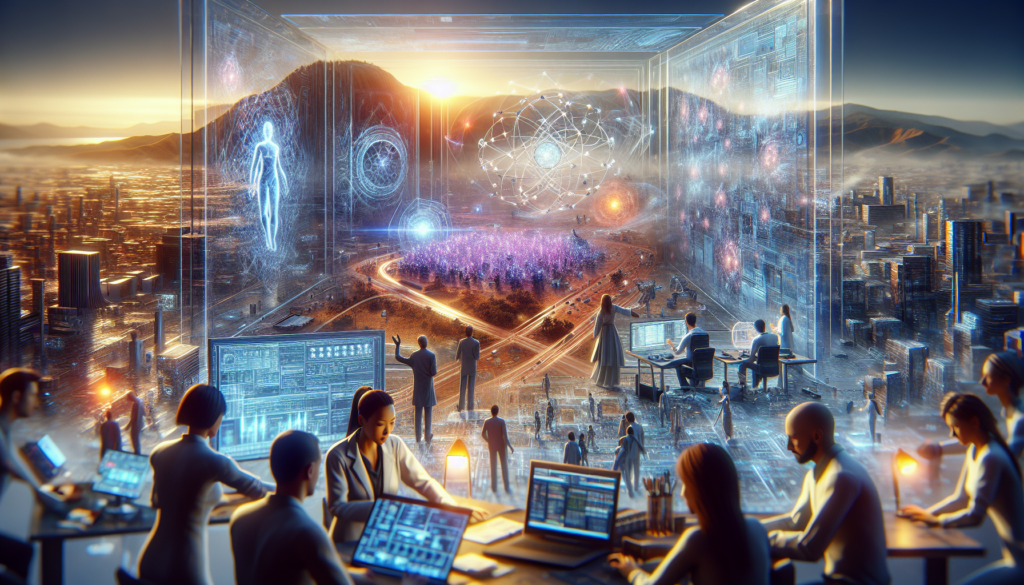
Imagine a world where computers can solve problems in seconds that would take today’s supercomputers millennia to crack. This isn’t the stuff of science fiction; it’s the promise of quantum computing. As we stand on the brink of a technological revolution, let’s dive into the fascinating world of quantum computing and explore how it intertwines with other emerging technologies to shape our future.
What is Quantum Computing?
At its core, quantum computing leverages the principles of quantum mechanics to process information in ways that classical computers can’t. While traditional computers use bits represented as 0s and 1s, quantum computers use quantum bits, or qubits, which can exist in multiple states simultaneously. This property, known as superposition, allows quantum computers to perform multiple calculations at once, exponentially increasing their processing power.
Another key feature of quantum computing is entanglement, a phenomenon where qubits become interconnected, and the state of one qubit can depend on the state of another, no matter the distance between them. This allows quantum computers to solve complex problems more efficiently than classical computers, from optimizing logistics to simulating molecular structures for drug discovery.
The Intersection of Quantum Computing and AI
Artificial Intelligence (AI) is another field poised to benefit immensely from quantum computing. Current AI systems, while impressive, are limited by the computational power of classical computers. Quantum computing could revolutionize AI by enabling the processing of vast amounts of data at unprecedented speeds, leading to more sophisticated machine learning algorithms and more accurate predictive models.
For instance, quantum machine learning could enhance natural language processing, allowing AI to understand and generate human language with greater nuance and accuracy. This could lead to more advanced virtual assistants and more effective communication between humans and machines.
Quantum Computing and Cybersecurity
As quantum computing advances, it also poses significant challenges and opportunities in the realm of cybersecurity. On one hand, quantum computers could break many of the encryption methods currently used to secure data, rendering them obsolete. On the other hand, quantum cryptography could provide unbreakable encryption, ensuring data security in the quantum era.
Quantum key distribution (QKD) is a prime example of how quantum mechanics can be used to create secure communication channels. By using the principles of quantum entanglement, QKD allows two parties to share encryption keys with absolute security, as any attempt to intercept the key would disturb the quantum state and be immediately detectable.
Emerging Technologies Complementing Quantum Computing
Quantum computing doesn’t exist in a vacuum; it’s part of a broader ecosystem of emerging technologies that are shaping our future. Let’s explore a few of these technologies and how they complement quantum computing.
5G and Beyond
The rollout of 5G networks is set to revolutionize connectivity, providing the high-speed, low-latency infrastructure needed to support quantum computing applications. As quantum computers become more integrated into our daily lives, the need for robust, high-speed networks will only grow. Future iterations of 5G, and eventually 6G, could further enhance the capabilities of quantum computing by enabling real-time data processing and communication.
Blockchain and Quantum Computing
Blockchain technology, known for its role in cryptocurrencies, could also benefit from quantum computing. Quantum algorithms could enhance the efficiency of blockchain transactions, making them faster and more secure. However, just as with cybersecurity, quantum computers could also pose a threat to current blockchain systems by potentially breaking the cryptographic algorithms that secure them.
Augmented Reality and Quantum Computing
Augmented Reality (AR) is another field that could be transformed by quantum computing. By processing vast amounts of data in real-time, quantum computers could enhance AR experiences, making them more immersive and interactive. Imagine walking through a city and seeing real-time data overlays on buildings, powered by quantum computing, providing you with information about historical events, current events, or even future projections.
The Challenges and Future of Quantum Computing
Despite its immense potential, quantum computing faces several challenges. One of the biggest hurdles is maintaining the stability of qubits, which are highly sensitive to environmental disturbances. Researchers are working on developing better error correction techniques and more stable qubit architectures to overcome these challenges.
Another challenge is the need for specialized infrastructure. Quantum computers require extremely low temperatures to operate, often near absolute zero, which necessitates expensive and complex cooling systems. As the technology matures, we can expect to see more cost-effective solutions emerge.
Looking to the future, the integration of quantum computing with other emerging technologies could lead to breakthroughs in fields such as medicine, finance, and environmental science. For example, quantum simulations could help design more effective drugs by accurately modeling molecular interactions, while quantum algorithms could optimize financial portfolios with unprecedented precision.
In conclusion, quantum computing represents a frontier of technology that promises to unlock new possibilities across various domains. As we continue to explore and develop this technology, its integration with other emerging technologies will undoubtedly shape the future in ways we can only begin to imagine.