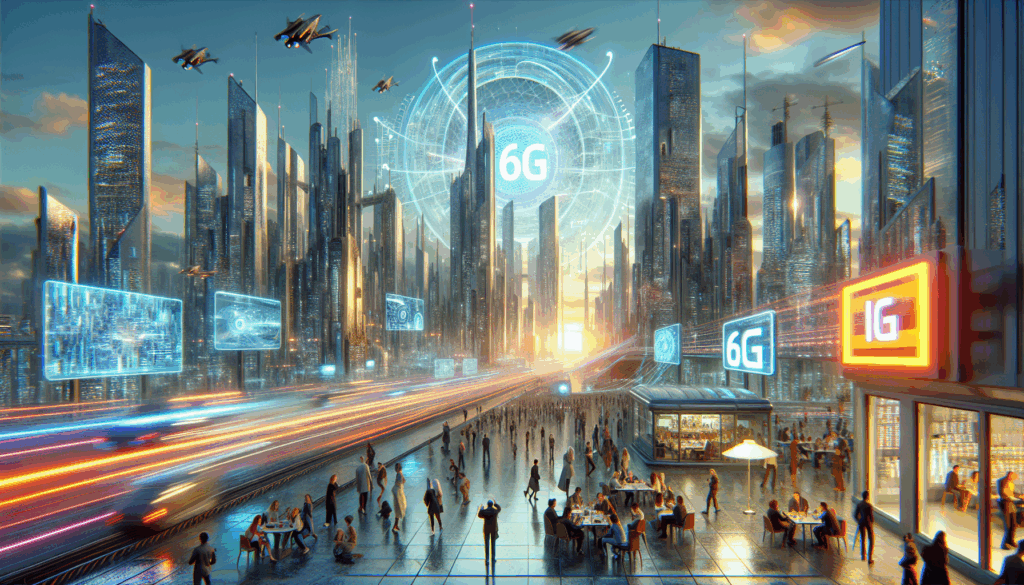
Imagine a world where the internet is so fast, it feels like you’re living in a sci-fi movie. That’s the promise of 6G technology, the next big leap in internet speed and connectivity. As we continue to rely more on the internet for work, entertainment, and communication, the need for faster and more reliable connections has never been more critical. In this article, we’ll dive into what 6G is, how it differs from its predecessors, and what it could mean for our future.
What is 6G?
6G, or the sixth generation of wireless technology, is the next step beyond the current 5G networks. While 5G has brought significant improvements in speed and latency, 6G aims to push these boundaries even further. The goal is to achieve speeds up to 100 times faster than 5G, with latency reduced to nearly imperceptible levels. This means downloading a full-length HD movie in less than a second or experiencing virtual reality without any lag.
But 6G isn’t just about speed. It’s also about expanding connectivity to more devices and improving reliability. Imagine a world where every device, from your smartphone to your refrigerator, is seamlessly connected and communicating in real-time. This is the vision of the Internet of Everything (IoE), and 6G is the technology that could make it a reality.
How Does 6G Differ from 5G?
To understand 6G, it’s helpful to compare it to its predecessor, 5G. While 5G introduced significant improvements in speed and latency, 6G aims to take these advancements to new heights. Here’s a quick comparison:
| Feature | 5G | 6G |
| Speed | Up to 20 Gbps | Up to 1 Tbps |
| Latency | 1-10 ms | Less than 1 ms |
| Device Connectivity | Millions per square kilometer | Billions per square kilometer |
| Frequency Bands | Sub-6 GHz and mmWave | Sub-THz and beyond |
As you can see, 6G is not just an incremental improvement but a significant leap forward. The use of higher frequency bands, such as sub-terahertz (sub-THz) and beyond, allows for much greater data capacity and speed. This shift also presents new challenges, such as signal attenuation and coverage, which researchers are working to overcome.
The Potential Applications of 6G
The possibilities with 6G are truly exciting. Here are some of the potential applications that could transform our lives:
Advanced Virtual and Augmented Reality: With 6G’s ultra-low latency and high speeds, virtual and augmented reality experiences could become seamless and indistinguishable from reality. Imagine attending a concert or a business meeting in VR without any lag or stuttering.
Smart Cities: 6G could enable the full realization of smart cities, where everything from traffic management to waste disposal is optimized in real-time. Sensors and devices across the city could communicate instantly, leading to more efficient and sustainable urban living.
Telemedicine: With 6G, remote healthcare could reach new heights. Doctors could perform complex surgeries using robotic systems controlled from thousands of miles away, or patients could receive real-time medical consultations with minimal delay.
Autonomous Vehicles: The ultra-reliable, low-latency communication of 6G could be crucial for the widespread adoption of autonomous vehicles. Cars could communicate with each other and with the infrastructure around them, making driving safer and more efficient.
Challenges and Considerations
While the potential of 6G is immense, there are also significant challenges to overcome. One of the main hurdles is the need for new infrastructure. The higher frequency bands used by 6G have shorter ranges and are more easily blocked by obstacles, which means more antennas and base stations will be required.
Another challenge is ensuring that 6G remains secure and private. As more devices and data become connected, the risk of cyberattacks and data breaches increases. Researchers are working on advanced encryption and security protocols to address these concerns.
Additionally, there’s the question of spectrum allocation. The higher frequency bands needed for 6G are currently used for other purposes, such as satellite communications. Negotiating and allocating these bands will be a complex process involving governments and international organizations.
The Road Ahead
The journey to 6G is just beginning. While some countries have already started research and development, it’s likely that we won’t see widespread 6G deployment until the 2030s. In the meantime, the focus is on refining 5G and laying the groundwork for the next generation of wireless technology.
As we look to the future, it’s clear that 6G has the potential to revolutionize how we live, work, and connect. From enabling new technologies like advanced VR and autonomous vehicles to transforming industries like healthcare and urban planning, the impact of 6G could be profound. While there are challenges to overcome, the promise of a faster, more connected world is an exciting prospect that’s worth pursuing.